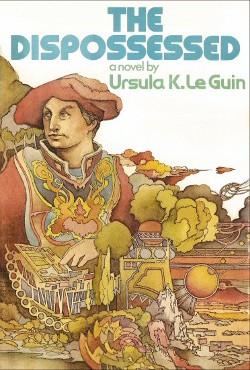
The Dispossessed
I started this book reivew page after reading The Left Hand of Darkness, which took me by storm. Then I also saw that The Dispossessed takes place in the same universe, and was often considered an equally (if not more) brilliant book. High expectations were impossible to avoid, which made me avoid reading it for two years.
The story unfolds on two sister worlds. Urras is quite similar to Earth, and a significant part of the story takes place in the capitalist and patriarchical country A-Io, which in many ways is very similar to the United States. Its moon Anarres is a harsh and barren world. Initially unhabited, a revolution at Urras lead to a large group of anarchists being allowed to leave and form their own independent society on Anarres. Though the book, we get to follow the protagonist, who is the first person from Anarres in over a 100 years that leaves to visit Urras.
The main theme in the book is the conflict between the capitalist culture of A-Io and the anarchist culture of Anarres. Initially, Anarres seems like a very successful mix between socialism and anarchy, where people are treated as equals and there are no governing bodies, no prisons, and no inequality. Conversely, A-Io is presented as a capitalist hellhole, where people only care about themselves and their property. This is in large part as we see the story through the eyes of an Annaresti. However, as the story unfolds, everything becomes more muddy, and both worlds each have their advantages and problems. This ideological conflict, and the surrounding societies, is something Le Guin handles beutifully.
I got very invested in this book. This was evident after I had to put down the book for over a week after the protagonist did something bad. Comparing the book to the similar The Left Hand of Darkness, I think the Dispossessed is more approachable, in part due to its captivating central story. I wuould recommend it to most people who enjoy science fiction, especially if they are interested in different political ideologies. In the end, it is very hard rating a book for which I've had such high expectations, but it is not hard to see why it won all three of the Hugo, Locus, and Nebula awards.